Governance that runs beforeyour AI executes.
Constitutional enforcement for AI systems — non-bypassable, fail-closed, and cryptographically proven.
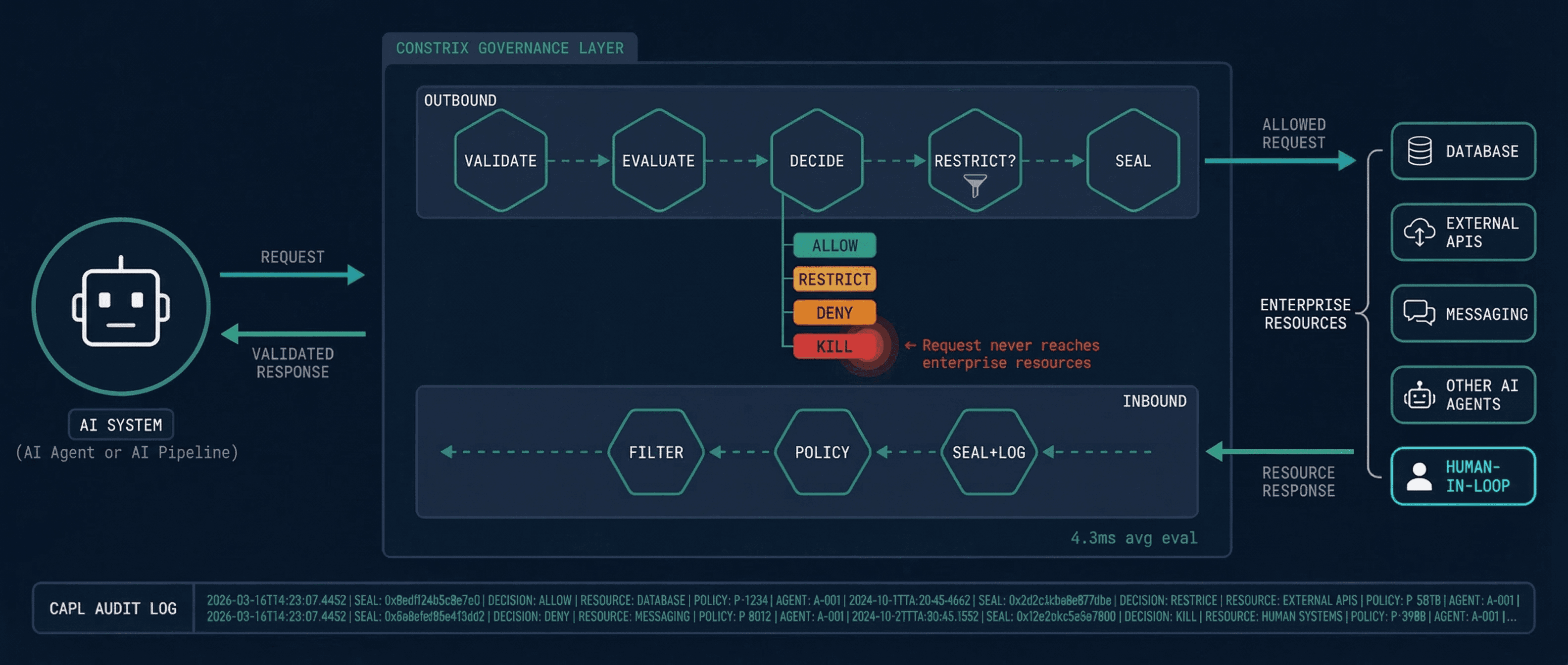
Constrix is the constitutional governance runtime for AI systems — every decision intercepted before execution, every action sealed with Ed25519, every agent cryptographically identified.
Enterprises deploying AI agents that need structural enforcement, audit-grade evidence, and regulatory proof — not advisory guardrails or post-hoc monitoring.
A non-bypassable 8-stage pipeline that seals every AI decision in under 5ms, identifies every agent with a short-lived AIT, governs every MCP tool call, and generates evidence packages your auditor can verify offline.
Trusted by engineering teams building governed AI systems
AI without governance is a liability. AI with bad governance is theater.
Every AI agent that executes without deterministic oversight is an unchecked risk. Prompts can be manipulated. Models hallucinate. Outputs bypass every layer you built. And when something goes wrong — the logs you have cannot prove anything.
Prompt injection finds every gap
Advisory guardrails are bypassed at the input layer. Malicious prompts override safety instructions. Your models comply with instructions they should never receive — because your governance layer is advisory, not structural. A configuration in a context window is not enforcement. A policy document is not enforcement. Enforcement is a property of the architecture.
Logs can be altered. Seals cannot.
You can record what your AI output. You cannot prove what it decided. Mutable server logs can be edited by any administrator with database access. Regulators and legal teams require mathematical proof — a cryptographic record that is independently verifiable and tamper-evident by construction. Not a log. A seal.
4,000+ MCP tools. No universal trust standard.
Every agent you deploy connects to external tools via MCP — databases, APIs, file systems, browser automation. The MCP ecosystem has grown faster than any governance standard could keep pace with. Tool poisoning, supply chain attacks, and excessive permission grants are structural risks in every MCP deployment. Without an intercepting proxy, every tool call is ungoverned.
Regulators ask for proof you can't produce.
The EU AI Act. NIST AI RMF. ISO 42001. They don't ask if your AI was behaving well. They ask if you can prove it was — with a tamper-evident record that existed at the time of the decision, attributed to a specific identity, verifiable without trusting your infrastructure. Probabilistic outputs and advisory policies do not satisfy an auditor's evidence standard. They never will.
Your agents are acting. You don't know which one.
Most enterprises give AI agents shared credentials — a single service account used by dozens of processes. When something goes wrong, your audit log shows what happened — but not which agent did it, on whose behalf, under what delegated scope. That is not attribution. That is noise. Without cryptographic agent identity sealed into every decision record, you have no chain of custody.
Constitutional governance. Not a monitoring layer. Not a policy dashboard. The enforcement is structural.
Constrix intercepts every AI decision at the runtime layer — before it executes. Policy-driven, cryptographically sealed, structurally non-bypassable.
Non-Bypassable
Governance enforcement is structural. There is no API call, configuration flag, or emergency override that skips the policy engine. Not a setting. Not a feature. A design constraint embedded in the architecture.
Fail-Closed
System failure, network timeout, internal exception — none of these silently permit an action. Constrix fails closed by design. The only way an action executes is if governance explicitly allows it.
Proof-Grade
Every decision produces an Ed25519-signed, CBOR-encoded audit record. Tamper-evident. Reproducible. Verifiable without trusting your infrastructure. This is not a log. It is proof that cannot be altered after the fact.
Every tool call. Governed. Sealed.
MCP is becoming the universal protocol for AI tool access — the standard through which every agent connects to every external capability. Thousands of servers. No universal trust verification standard. No structural governance layer. Constrix intercepts every MCP tool invocation before it reaches the server. Validates server identity. Evaluates tool-call policy. Seals the outcome. Returns the decision in under 7ms. The swarm never knows governance happened. Your auditor sees everything.
Read MCP Governance Docs →Transparent Proxy
No code changes in your agent or swarm. Point your MCP client at the Constrix proxy endpoint. Everything else is automatic. One environment variable. Full governance.
MCP Threat Coverage
Tool poisoning, supply chain attacks, excessive permissions, prompt injection via tools — every major MCP attack vector is addressed structurally at the proxy layer before any tool invocation reaches an MCP server.
CAPL MCP Chain Log
Every MCP call: server identity, tool name, parameters hash, agent identity, decision, and Ed25519 seal — in one auditable record. The complete chain, tamper-evident.
Cryptographic Identity
Every agent boots with a short-lived, Ed25519-signed Agent Identity Token (AIT). Verified in under 1ms. No network call. No shared secrets. The private key never leaves the agent.
Delegation Chain
When Agent A instructs Agent B, the authority chain is recorded. Every CAPL record shows the full delegation path — from human to orchestrator to sub-agent — sealed and tamper-evident.
Ghost Detection
Constrix knows when an agent stops generating governed activity. Dormant agents — credentials still live, no owner watching — are detected, flagged, and auto-revoked before they become attack surface.
Sealed Lifecycle
From first evaluation to planned decommission, the complete agent lifecycle is in the CAPL audit record. Registration, active operation, ghost status, final decommission summary — all cryptographically sealed.
Your agents have names now. And a record of everything they did.
Every AI agent that touches your systems is a non-human identity. Most enterprises give AI agents shared credentials — a service account used by dozens of processes simultaneously. When an agent goes dormant, its credentials stay live. When an agent is compromised, there is no identity trail to follow — just a shared account ID in a server log. Constrix AgentID gives every agent a cryptographically verified, short-lived identity token, sealed into every CAPL record it generates. You always know who acted, on whose behalf, with what delegated scope. And when an agent goes quiet — Constrix finds it before it becomes attack surface.
boot → eval → active → dormant → ghost → revoked
Ghost agents auto-detected from CAPL activity. No polling required.
Your regulations, written as governance rules. Evidence packages, generated automatically.
Every regulation your organization is subject to — the EU AI Act, NIST AI RMF, ISO 42001, SOC 2 — makes the same demand: prove that your AI acted within controlled, documented, auditable boundaries. ComplyAI reads those regulations and creates the governance rules that enforce them in Constrix. Your compliance score updates in real time. When an auditor asks for evidence, you export a package — sealed, structured, and formatted for their review. Not logs. Not screenshots. Cryptographic proof, organized by regulation article.
Regulation Knowledge Base
EU AI Act. NIST AI RMF. ISO 42001. SOC 2. Mapped to specific Constrix controls with full evidence package generation. Regulatory alignment also available for GDPR, HIPAA, and Saudi SDAIA. Updated as regulations evolve.
Automatic Policy Generation
ComplyAI converts regulation articles into governance rules. What regulators require becomes what your AI is structurally required to do. No manual translation. No interpretation gaps.
Evidence Package Export
When your auditor arrives, you export a package. Sealed records, organized by regulation article. Every claim backed by cryptographic proof — verifiable without trusting your infrastructure.
8-Stage Evaluation Pipeline
Every AI action passes through a deterministic, ordered evaluation sequence. No stage can be skipped.
Input Validation
Context Loading
Policy Compilation
Pre-Eval Expansion
OPA Evaluation
Post-Eval Expansion
Cryptographic Seal
Emit
Built for production scale
P50 evaluation latency
P99 evaluation latency
Kill decision latency
Evaluations per second
Your AI stack already has guardrails. None of them are governance.
Governance that can be bypassed is not governance. Monitoring that comes after the fact is not enforcement. Logs that can be altered are not proof. Credentials that live forever are not identity. Constrix is the layer that makes those distinctions enforceable.
Prompt Engineering & Guardrails
Advisory only. Every guardrail lives in a context window that a malicious prompt can override. The model changes — your guardrails break silently. There is no cryptographic proof these rules were active during an audit. They were suggestions. Never enforcement.
Advisory. Not governance.OPA / Policy Engine Alone
OPA is the right policy language. Constrix extends it into a governance runtime. OPA alone produces no sealed audit trail, has no agent identity layer, no AAB credential governance, and no MCP proxy. It evaluates policy — it does not enforce it structurally.
Policy evaluation. Not a governance runtime.AI Observability & Monitoring
Observability tools show you what happened — after it happened. The AI already acted. There is no enforcement, no interception, no seal. A breach you can observe after the fact is still a breach. Observation is not prevention.
Post-hoc visibility. Not enforcement.AI Gateway / LLM Router
AI gateways control who can call which model at what rate and cost. That is access control — a necessary layer. But they do not govern what the AI is permitted to decide, do not seal decision records, have no agent identity, and have no OAuth infrastructure for AI agents.
Access control. Not decision governance.Constitutional Governance Runtime
- Structural enforcement — not advisory
- Ed25519 sealed proof — not a mutable log
- Cryptographic agent identity on every CAPL record
- MCP tool call interception before execution
- OAuth 2.1 Agent Access Broker — policy-gated credentials
< 5ms
P50 latency
Zero
Silent failures
Ed25519
Cryptographic seal
8-stage
Deterministic pipeline
P50 evaluation latency. Not a benchmark — a production runtime guarantee built into the architecture.
Non-bypassable is a structural property of the architecture. Not a configuration option. Not a feature flag.
Ed25519 + CBOR. Tamper-evident. Independently verifiable without trusting Constrix infrastructure or team.
Agent Identity Token verification is offline. No network call. No shared secrets. No excuses at audit time.
Your agents are acting right now. Do you know which one? Can you prove it was allowed to?
Free tier. No credit card. First sealed decision in under 5 minutes. Full 8-stage pipeline, Ed25519 seals, and 7-day CAPL retention from day one. Enterprise pilots with dedicated onboarding available.